Book Review: If this Be Magic
The Unlikely art of Shakespeare in translation by Daniel Hahn
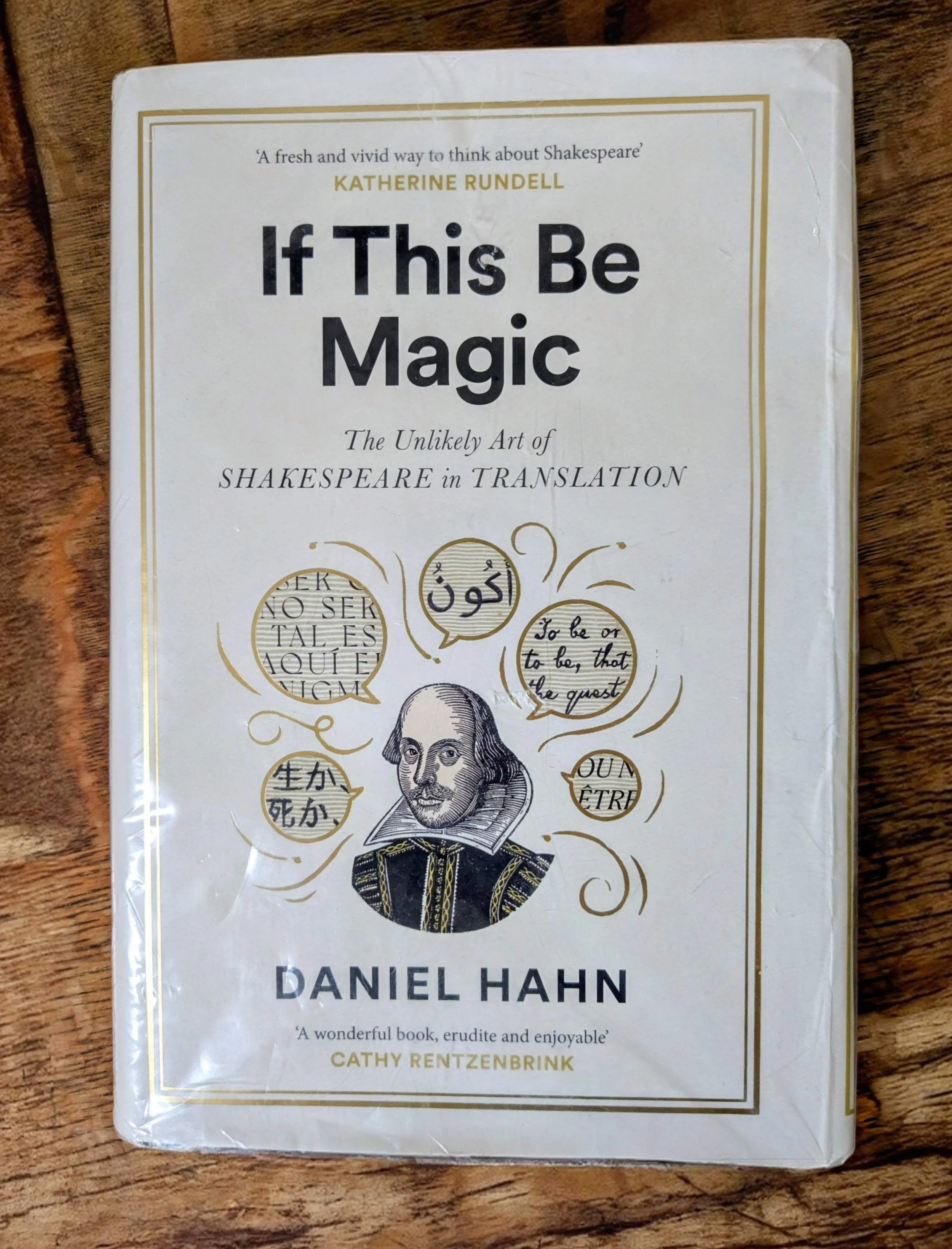
For lovers of translation, Shakespeare or neither!
I recently finished reading this great book about how Shakespeare is translated in a number of different languages. Although it focuses primarily on Danish, German, French and Brazilian Portuguese, it also looks a host of other languages from across the globe, including minority languages like te reo Māori and Welsh. Having not studied any Shakespeare since my A-levels, I was obviously approaching this book as a language lover and translator. And from that perspective, it gave me everything I could want and more.
The challenges for translators of Shakespeare are many. Do you force iambic pentameter onto your own language or do you find something else that works? How do you approach accents or changes in register? And what about jokes that just won’t work in your own language? It certainly made me appreciate the fact that corporate reports and car manuals tend not to be written in verse! It also provides some amazing insights into how different languages work. For instance, I never knew that Japanese tends not to use rhyme or that Georgian is an agglutinative language, where prefixes and suffixes can be added to a verb to show you the tense of the verb and who is performing it.
However, I also found it a great read for understanding and appreciating Shakespeare. For me, the way that Daniel Hahn broke down iambic pentameter to show how it is translated (or not) in other languages was also just really good for understanding how it works in English. As I said, my Shakespeare days have long since passed and even the phrase “iambic pentameter” was just another concept that rattled around my brain alongside standard deviation and photosynthesis, so having this knowledge refreshed in such an accessible way was brilliant. Later in the book, Hahn also explains how Shakespeare uses different vocabulary for different people – with a certain characters using longer, Latin-based words while others use shorter Saxon-root words. Obviously, he is using this point to demonstrate some of the challenges facing translators, but I think it could be a great resource for teaching students of Shakespeare, too. Teaching Shakespeare to teenagers is no mean feat I imagine, and this book is so readable and accessible that I will probably seek it out again when my kids are a bit older!
The one thing that did niggle me while reading was that it seemed to highlight some gender disparity in Shakespearean translation. While Hahn deployed “she” to refer to the impersonal translator, the majority of the translators he interviewed for his book were male. I found this to be particularly interesting given that translation in general is a female-dominated profession. I have pondered about gender and class divides in the world of translation before but I will save those thoughts for another time!
So to sum up: a fully recommended read for lovers of translation, lovers of Shakespeare and lovers of words in general.
Beth x